China Girl Holly vs Blue Princess Holly: Key Differences
Both China Girl Holly and Blue Princess Holly are Meserve hybrid evergreens bred for cold hardiness and reliable berry production. If you're shopping for an evergreen shrub that can handle winters in zones 5 through 9, you've likely seen both names. They look similar, thrive in similar conditions, and both deliver winter color and structure. But they are not identical, and the differences matter depending on your space and landscape goals.
This guide walks through what separates them so you can choose with confidence.
Quick Comparison at a Glance
| Attribute | China Girl Holly | Blue Princess Holly |
|---|---|---|
| Botanical Name | Ilex x meserveae 'China Girl' | Ilex x meserveae 'Blue Princess' |
| Hardiness Zones | 5-9 | 5-9 |
| Mature Height | 8-10 ft (to 10-15 ft unpruned over decades) | 8-10 ft (compact habit) |
| Mature Width | 6-8 ft | Narrower, columnar form |
| Growth Rate | Slow to moderate, 6-12 in/year established | Moderate (check regional nursery specs) |
| Berry Production | Heavy red berries (on pollinated females) | Heavy red berries (on pollinated females) |
| Male Pollinator Needed | China Boy or compatible male | Blue Prince or compatible male |
| Best Light | Full sun to part shade; best berries in full sun | Full sun to part shade |
China Girl Holly: The Established Standard
China Girl Holly has been the go-to choice since the Meserve breeding program brought cold-hardy hollies to northern regions in the 1950s and 60s. It remains reliable, well-understood, and widely available across North America.
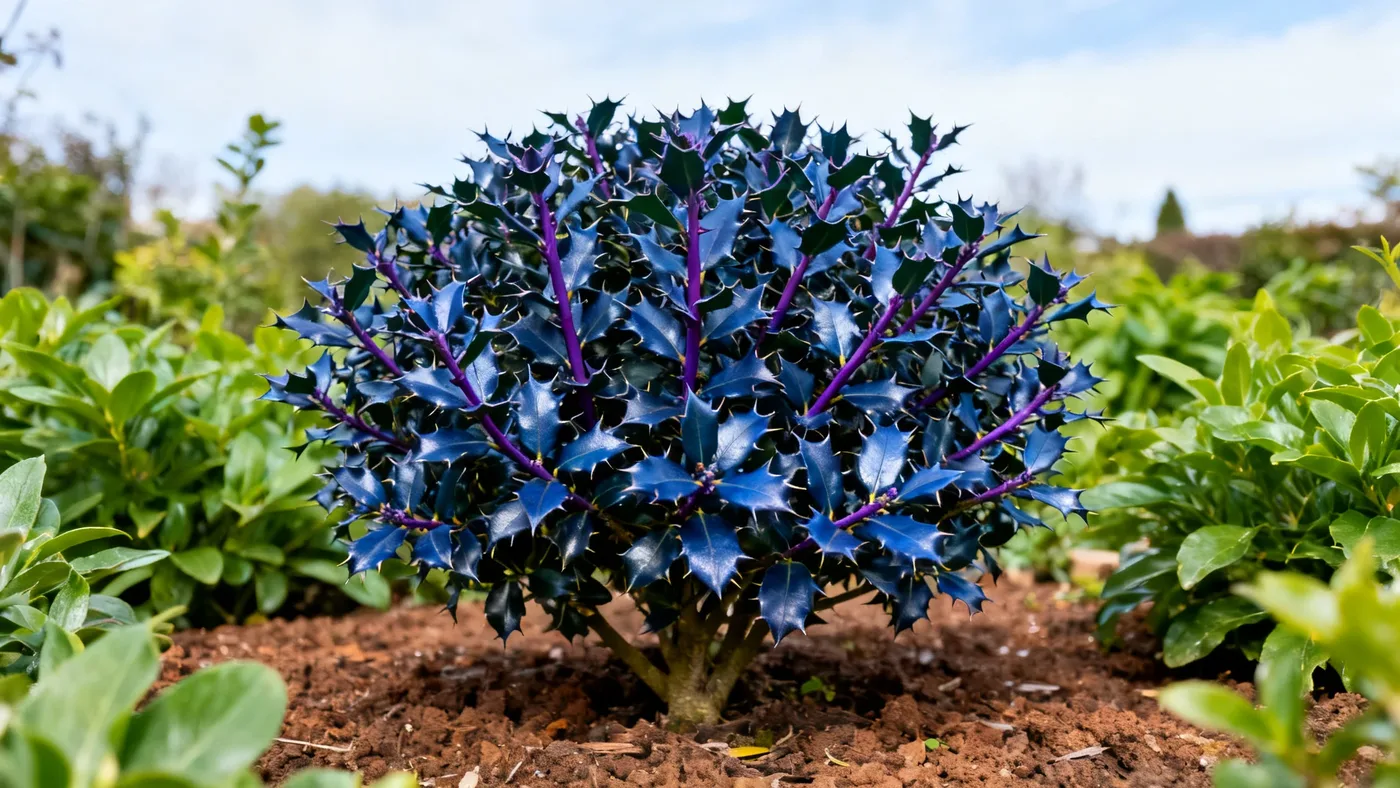
What it does well: China Girl reaches 8 to 10 feet tall and 6 to 8 feet wide at maturity, making it a substantial privacy screen or specimen shrub. The dark blue-green, glossy foliage stays dense year-round. New stems emerge with a purplish tint, adding visual texture through every season. In late spring (typically May, though timing varies by region), tiny white flowers appear, followed by bright red berries on female plants that receive pollen from a nearby male like China Boy. Those berries persist through winter and feed songbirds.
Growth is slow to moderate, roughly 6 to 12 inches per year once established. Patience is required, but the payoff is substantial: a long-lived shrub (commonly 40 to 50-plus years with decent care). China Girl performs in full sun to part shade, though berry production and foliage density are best in full sun. It adapts to loam, clay, or sandy soil as long as drainage is adequate, and it prefers acidic to neutral soil in the 5.0 to 6.5 pH range. It tolerates salt well, making it solid for coastal landscapes and road-salt exposure areas.
Drawbacks to consider: Spiny leaves require careful handling (a feature if you want a wildlife barrier, a liability if young children play nearby). The plant develops chlorosis (yellowing) in strongly alkaline soil, so a soil test is prudent in high-pH regions. Without a male pollinator nearby, you get foliage and structure but no berries. And while the spiny leaves deter casual deer browsing, China Girl is not fully deer-proof, especially when plants are young or deer pressure is high.
Blue Princess Holly: The Compact Alternative
Blue Princess Holly is another Meserve hybrid, equally hardy and equally suited to cold winters. It is often chosen when space is tighter or when an upright, refined form is preferred over a full, rounded spread.
What it brings: Blue Princess shares China Girl's evergreen structure, spiny foliage, and berry production. Like China Girl, it is a female form requiring a male pollinator (typically Blue Prince) for reliable fruiting. Both grow in zones 5 through 9 and thrive in full sun to part shade. Both are long-lived and require minimal ongoing maintenance once established.
The defining difference is habit. Blue Princess tends toward a columnar, compact growth pattern compared to China Girl's broader, more rounded form. This makes Blue Princess ideal when you need height without spreading outward, such as in narrow screening applications, along fence lines, or as a foundation accent where horizontal space is limited. It still reaches approximately 8 to 10 feet tall, but the width remains notably less than China Girl's 6-to-8-foot spread. For precise measurements and growth performance in your specific region, consult your local nursery or extension service, as growing conditions and cultivar selection vary by location.
Drawbacks to consider: The main trade-off is that Blue Princess's narrower habit means fewer branches and potentially less dense overall foliage than a full-width China Girl. If maximum screening density is your goal, China Girl often wins. Like China Girl, it requires a compatible male (Blue Prince) for berries; planting it alone will not produce reliable fruiting. And as with China Girl, it is not fully deer-proof in regions with high browse pressure.
Head-to-Head: Growing Conditions and Care
| Growing Factor | China Girl Holly | Blue Princess Holly |
|---|---|---|
| Soil Type Preference | Well-drained loam, clay, or sandy (pH 5.0-6.5 ideal) | Well-drained, acidic to neutral (check local specs) |
| Drought Tolerance | Moderate once established; best with consistent moisture | Moderate, similar to China Girl |
| Salt Tolerance | Good; tolerates coastal and road-salt conditions | Good, similar to China Girl |
| Pruning Approach | Light shaping late winter to early spring; tolerates hard shearing for hedges | Similar; responds well to shaping |
| Common Issues | Chlorosis in alkaline soil, no berries without male, winter leaf scorch in windy sites | No berries without male; regional pest/disease considerations |
Growth Timeline: What to Expect
Both China Girl and Blue Princess reach flowering age within a few years of planting. White flowers appear in late spring, and if pollinated, red berries develop through summer and persist into winter, reaching peak display in December and January. Full mature size takes approximately 10 to 15 years depending on soil, water, and sunlight.
Plan for slow to moderate growth at 6 to 12 inches per year for China Girl once it is established. Year one focuses on root development, so visible top growth is modest. By years three to five, you will see more substantial annual gains. Year-to-year performance varies by region, soil condition, and water availability. Spring to early summer is the active growth window; growth slows in heat and dormancy.
For detailed planting steps, ongoing care through the seasons, pruning technique, fertilizing schedules, and troubleshooting common problems, see our complete China Girl Holly care guide. Much of that guidance applies directly to Blue Princess as well, since both share the same parentage and hardiness range.
Which Holly Fits Your Landscape?
Choose China Girl Holly if: You want maximum density and screening power. You have 6 to 8 feet of horizontal space. You are building a substantial hedge or specimen planting. You prefer a full, rounded form over an upright silhouette. You are in a windy or coastal location and value its salt tolerance. You want the widest nursery availability and the most track record in your region.
Choose Blue Princess Holly if: Your space is narrower and you need height without outward spread. You are planting along a fence line or boundary where width must be controlled. You prefer a formal, columnar appearance. You are matching an existing Blue Princess Holly or Blue Prince male partner already on your property. Your region stocks Blue Princess readily and can advise on its performance locally.
Ask your local nursery or extension service if: You are unsure about space, growth rate, or performance in your specific zone and soil type. Both cultivars are regionally popular for good reason, and local growers can steer you toward whichever suits your climate, drainage, and landscape best. Regional availability and cultivar performance often drive the best choice.
Quick Reference: China Girl vs Blue Princess
- Both are cold-hardy Meserve hybrid hollies, zones 5-9
- Both produce bright red berries if pollinated by a compatible male (China Boy or Blue Prince)
- China Girl reaches 8-10 ft tall by 6-8 ft wide; full, rounded form
- Blue Princess reaches 8-10 ft tall; narrower, columnar habit
- Both prefer full sun for best berry production, though part shade is tolerated
- Both need acidic to neutral, well-drained soil (avoid strongly alkaline pH)
- Both tolerate salt and coastal conditions well
- Both are long-lived shrubs, 40-50-plus years with good care
- Neither is fully deer-proof, though spiny foliage deters casual browsing
- China Girl grows 6-12 in/year once established; full maturity in 10-15 years
- Blue Princess grows at a similar rate but reaches full size in a narrower footprint
- Choose China Girl for screening, width, and maximum density
- Choose Blue Princess for narrow spaces and columnar form
- Both need a male pollinator for reliable red berries