China Girl Holly Buying Guide: Container Sizes Explained
Buying China Girl Holly (Ilex x meserveae 'China Girl') is straightforward once you understand what to look for. Whether you are starting a hedge, screening a property line, or planting a specimen shrub, the quality of the plant you bring home matters far more than how much you spend. This guide walks you through container sizes, what healthy foliage looks like, where to buy with confidence, and which red flags signal a plant to pass on.
Understanding China Girl Holly Container Sizes
China Girl Holly is typically sold in three container sizes at retail nurseries: quart, #1 (one gallon), and #3 (three gallon). Each size has a place in different planting strategies.
Quart containers hold young plants, usually 8 to 16 inches tall. These are budget-friendly and work well if you are patient; they catch up to larger sizes within a few years because the growth rate is slow to moderate, roughly 6 to 12 inches per year once established. Quart plants are lightweight, easy to handle in quantity, and ideal for large hedging projects where you want to spread cost over time.
#1 containers (one gallon) are the middle ground. These plants are typically 12 to 24 inches tall, more developed than quarts, and far more common at garden centers. A #1 China Girl Holly has enough root development to establish faster than a quart, yet costs less than a #3. Most home gardeners choose #1 for single specimens or small groupings of 3 to 5 plants.
#3 containers (three gallon) hold the largest nursery-grown China Girl Holly plants. These typically stand 2 to 3 feet tall with denser branching and fuller appearance straight from the truck. A #3 gives immediate visual impact and establishes quickly in a mature garden. It is the choice when you want landscaping results within a season. Keep in mind: China Girl Holly reaches mature dimensions of 8 to 10 feet tall and 6 to 8 feet wide, so even a #3 container plant needs 10 to 15 years to fill that space.
Container size does NOT determine the final size of your shrub. All three sizes will eventually reach the same mature height and width. Container size only controls how much development has already happened and how quickly the plant fills in.
What to Look For in a Healthy Plant
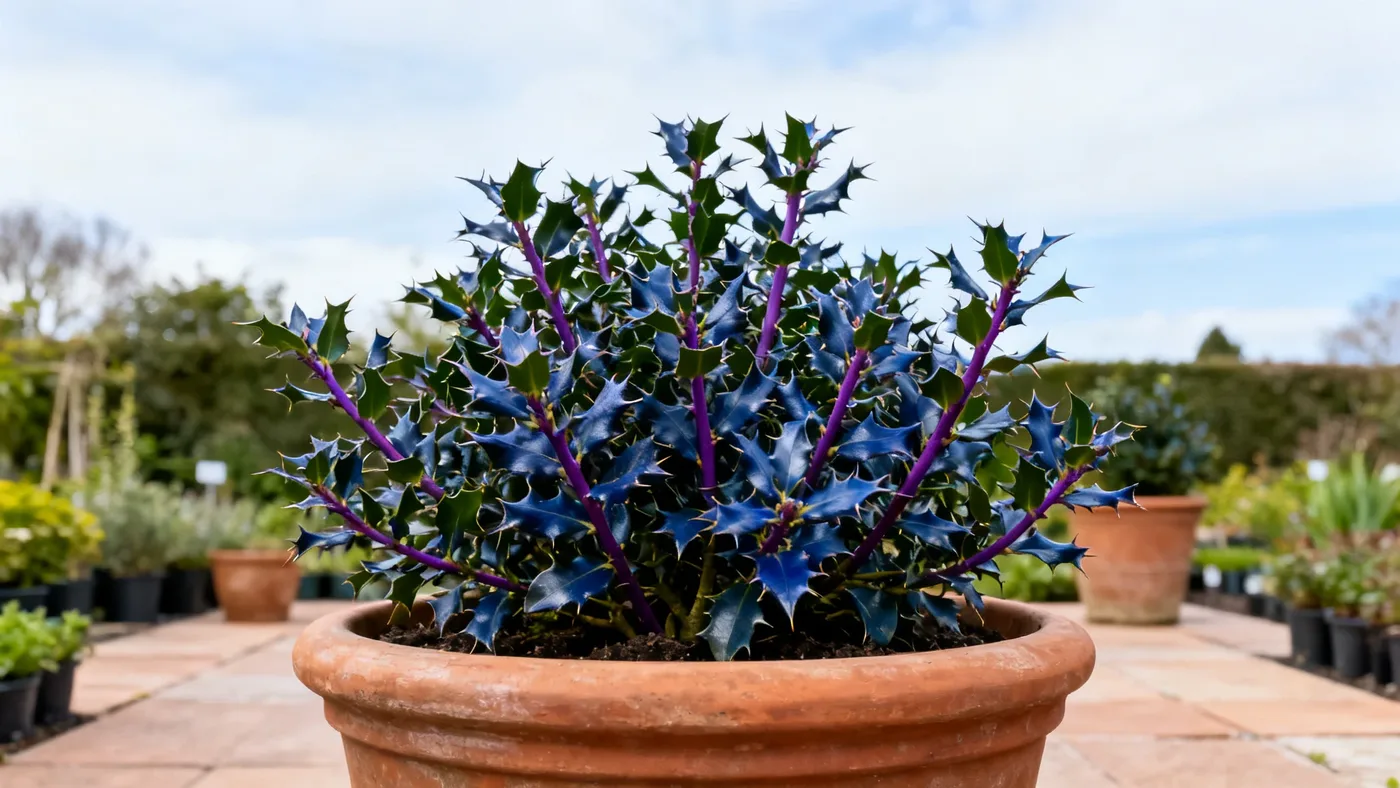
Foliage color is the first health indicator. Healthy China Girl Holly has dark blue-green, glossy leaves year-round. The stems are often tinged purple, especially on new growth. If the foliage looks pale yellow or dull, or if leaves show brown tips and edges, the plant is stressed. Yellowing can signal alkaline soil at the nursery (China Girl Holly prefers acidic to neutral soil around pH 5.0 to 6.5) or inconsistent watering. Pass on yellowing plants unless you are certain the cause is temporary nursery stress, not a deeper problem.
Examine the leaves for pest damage. Look underneath for scale insects, spider mites, or signs of holly leafminer (tiny tracks inside the leaves). A few spotted leaves on an otherwise vigorous plant are minor; heavy pest pressure is a red flag. Nurseries should catch and treat pest problems before sale, so significant infestations suggest poor nursery care.
Check the soil. Squeeze a handful gently: the soil should feel moist but not waterlogged or bone-dry. If the soil is hard and pulls away from the container edges, the plant is severely rootbound and has been neglected. A moist, firm root ball signals recent care and good establishment potential.
Inspect the branching structure. In a #3 or #1 container, you should see multiple main stems, not a single central trunk. The plant should be roughly symmetrical and full, not sparse or lopsided. Gaps in foliage reveal weak structure underneath and slower filling in the landscape.
Check for visible roots circling the soil surface or poking from drainage holes. Some roots in the holes are normal; dense matting or thick roots wrapped around the ball indicate the plant has been in the container too long and may struggle to establish in the ground.
Key Features to Compare Before Buying
Berry production is a major selling point of China Girl Holly. Female plants produce bright red berries in winter, an excellent food source for songbirds and striking against the dark foliage. However, berries only appear on female plants that have been pollinated by a male plant (such as China Boy Holly, the registered male counterpart). If you want guaranteed winter color, purchase at least one male plant nearby or confirm your neighbor has one within 100 feet. If you buy a single female with no male within pollinating distance, you will have a beautiful foliage shrub but no berries.
Ask the nursery whether the plant has been pollinated or if it comes from a growing area with male plants nearby. Unpollinated females often bear no fruit their first winter. A healthy female with steady berry production is worth a small premium.
Salt tolerance is another consideration if you garden near roads treated with winter salt or near the coast. China Girl Holly tolerates both road salt and seaside conditions well, so this should not sway your choice unless you are comparing it to a salt-sensitive shrub.
Deer resistance matters in many gardens. China Girl Holly's spiny leaves are a natural deterrent, though hungry deer or young plants can still sustain damage. Nurseries in high-deer areas often have established plants with minimal browse marks; these are proof the shrub earns its reputation.
How to Choose by Your Growing Conditions
China Girl Holly thrives in USDA zones 5 through 9. If you garden outside this range, the plant may not survive winter cold or may struggle in heat. Verify your zone before purchasing any size.
Sun exposure affects both appearance and berry production. China Girl Holly grows in full sun to part shade, but the densest foliage and best berry production occur in full sun. If your site receives 4 to 6 hours of direct sun daily, a #3 container plant will show better berry set within 2 to 3 years than a smaller plant. In shadier sites, all three sizes eventually reach mature dimensions, but denser specimens come from sunnier locations.
Soil quality matters less for initial establishment than it does long-term. China Girl Holly adapts to loam, clay, or sandy soil as long as drainage is decent. Poor drainage causes root rot, the main killer of established plants. If your site has wet, compacted soil, invest in adding organic matter when you plant, regardless of container size.
Common Buyer Mistakes to Avoid
Buying too small a container expecting it to catch up quickly is the biggest mistake. A quart plant will catch up, but "catching up" takes 3 to 4 years. If you need screening or privacy within a year, invest in #1 or #3 plants from the start.
Purchasing a single female without a male pollinator, then expecting berries. Unless your neighbor's garden has a male China Boy or similar cultivar, your female will remain fruitless. Always ask about this at point of sale or plan to add a male plant later.
Choosing a plant based on a single visit to the nursery. Visit twice if possible, a week apart. A stressed plant may look acceptable one day but visibly decline the next. If foliage looks worse on your second visit, it signals poor health or unsuitable nursery conditions.
Buying in late summer or fall and expecting it to establish before winter. While fall is a legitimate planting season, plants purchased in late summer have minimal time to root before soil cools. Early spring purchases allow the full growing season for establishment. If you must buy in late summer, choose a larger container for better immediate root mass.
Overlooking the plant's final size. China Girl Holly matures at 8 to 10 feet tall and 6 to 8 feet wide. If you have a 6-foot-wide foundation bed, one mature plant will crowd it. Plan spacing at 6 to 8 feet apart for hedging or screening; wider for specimen plantings. A #3 container looks small in a large space, but in 10 to 15 years it becomes large.
Where to Buy China Girl Holly
Local independent nurseries are your best source. Staff can answer questions about foliage quality, berry production, and pollination needs. They stand behind their plants and can advise on establishment care. Visit in spring or early fall for the widest selection of container sizes.
Regional garden centers stock all three sizes year-round in zones 5 through 9. Check their inventory online, then visit in person to inspect foliage and soil condition before purchasing. Many offer planting services and guarantees, a safeguard worth considering.
Specialty nurseries focused on native and adapted plants often carry China Girl Holly's relatives (Blue Princess, Blue Prince) alongside this cultivar, letting you compare quality across cultivars.
Online ordering from mail-order nurseries works when you cannot find local stock, though shipping and establishment timelines differ. Most reputable online nurseries ship bare-root or balled-and-burlapped plants in spring or fall. Container-grown plants from online sources arrive more established but with higher shipping costs due to weight.
Quick Reference Buying Checklist
| Container Size | Typical Height | Growth Rate | Best Use | Establishment Timeline |
|---|---|---|---|---|
| Quart | 8-16 inches | 6-12 in/year | Large hedges, budget projects | 3-4 years to fill in |
| #1 (1 gallon) | 12-24 inches | 6-12 in/year | Most landscapes, small groups | 2-3 years to mature appearance |
| #3 (3 gallon) | 2-3 feet | 6-12 in/year | Immediate impact, fast screening | 1-2 years to established look |
Health Indicators Checklist
- Foliage is dark blue-green and glossy, not pale or yellow
- New stems show purple tinting
- No visible pest damage or webbing underneath leaves
- Soil is moist but not waterlogged; container is neither too heavy nor bone-dry
- Branching is full and symmetrical, not sparse or one-sided
- No thick matted roots circling the soil or choking drainage holes
- Plant is appropriate size for your garden's zone (5-9) and sun exposure
- If purchasing a female, confirm pollinator availability nearby
Once you bring your China Girl Holly home, refer to the complete growing guide for planting depth, watering schedules, and ongoing care. The investment in selecting a healthy plant at purchase pays off in decades of reliable performance and winter berries.