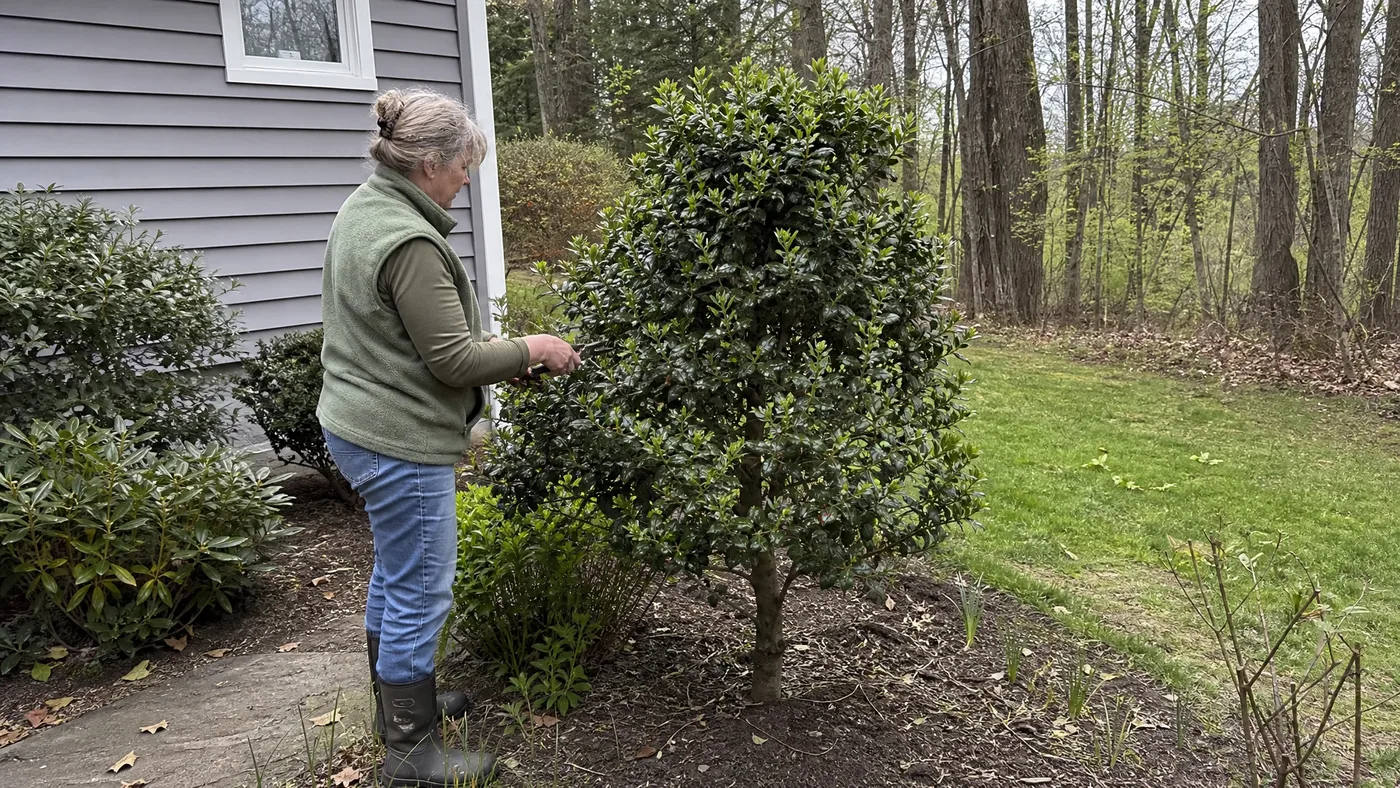
Training China Girl Holly as a Small Tree or Topiary
Look at the two receipts side by side. One three-gallon China Girl holly sits on one line, and a ready-made standard holly sits on another at several times the price. The gap between them is not the plant. It is about four years of someone else's pruning, staking and waiting, and you can do that work yourself.
Below, you'll find out all about training China Girl as a small tree or a clipped topiary, including how to pick the leader, how many branches to remove each season, what to stake with, how to build the crown, where the topiary path splits off, and what the finished tree really costs. We follow one plant from the pot to the finished form.
Done well, you get a clean trunk under a glossy evergreen head. Done badly, you get a bare, leaning stem with a tuft on top.
A Three-Gallon China Girl Holly and a Four-Year Plan
Every number in this guide belongs to one plant, so you can hold your own shrub up against it. This section sets out the example we follow all the way through.
The Plant, the Goal and the Budget
The plant is a single three-gallon China Girl. We grow it in that size, and the plan starts there. The goal is a single-trunk standard with a rounded head. The budget is the shrub, one stake, a set of soft ties and a pair of sharp bypass pruners. If you are still choosing a pot size, our container size buying guide explains what each one gives you.
Why This Takes Years
China Girl is dense and multi-stemmed, and arboretum descriptions call its habit compact and upright-rounded. Left alone, the cultivar grows to 10 feet tall and wide, a good deal more than the 3 to 8 feet usually quoted for the species. A standard holds all that mass in a small head on a bare trunk.
Growth is also slow. These hollies have a slow growth rate, so the trunk thickens at its own pace and you cannot hurry it. That slowness is why the plan is paced in years.
The Order of Work Across Four Years
Here is the sequence we follow for this plant, and the rest of the guide takes each step in turn.
- Year one: pick the leader and remove the stems that compete with it.
- Years one and two: take off the lower branches in stages, never all at once.
- Year two: stake the trunk and check it as it thickens.
- Year three: build the rounded head and set the clip height.
- Year four: hold the shape, take off the stake once the trunk stands alone, and clip lightly.
Choosing the Leader in Year One
The leader becomes the trunk, so this is the one decision you cannot easily undo. Make it before you make any other cut.
Find the Strongest Upright Stem
Stand back from the plant at eye level and look for the stem that is straightest, thickest and closest to the center of the root ball. Tie a bright strip of cloth around it so you do not lose it among the others. A leader that stands clearly above its neighbors needs little help. A leader that leans or forks low will give you a crooked trunk in year three.
Remove the Competitors
Now deal with the stems that rival it. Work in this order:
- Cut out any stem that is crossing, rubbing or growing straight up beside the leader.
- Cut each one back to its base or to the branch it grows from, leaving no stub.
- Leave the leader's tip completely untouched.
- Leave the side branches for now. They come off later in stages.
If two stems are truly matched, remove the weaker one and leave the other. In our rows, the plant that ends up with a crooked trunk is nearly always the one that kept two equal stems for a second year.
Check the Roots Before Blaming the Cuts
If the leaves turn yellow after this first round, the cause is rarely the pruning. China Girl wants slightly acidic, well-drained soil, and a pot that stays wet or a pH that has drifted upward shows up as yellow leaves first. Fix the soil, then carry on. A shrub that is already struggling should not lose branches.
Limbing Up China Girl Holly, Cut by Cut
Limbing up means removing the lower branches so the trunk shows. With this plant the secret is to do it slowly, one tier at a time, over two seasons.
Why You Do Not Strip It at Once
Common advice says to clear the trunk bare in a single session so you can see the finished tree. We do not follow it. The lower leaves are still feeding the trunk, and a slow-growing holly stripped overnight gives you a thin, weak stem under a heavy top. It also tends to throw shoots from the bare wood as it protests.
The Order of Removal
Cut in winter while the plant is dormant, since you should prune in the winter to maintain shape. Wear thick gloves, because the leaves are spine-tipped. Then follow this sequence:
- Remove only the lowest tier of branches, the ones nearest the soil, with clean cuts just outside the branch collar.
- Shorten the next tier up by about half rather than removing it. These branches keep feeding the trunk.
- Rub off or snip any small shoots that appear on the trunk as soon as you see them.
- The following winter, take off the tier you shortened and shorten the one above it.
Reading the Plant Between Cuts
After each round, give the plant a full season before the next. Healthy glossy leaves on the upper branches and steady new growth at the leader mean you can proceed. Pale or dropping leaves mean you wait and check water and drainage first. Clipped hollies also draw pests, and the likely ones are leafminers, spider mites, whiteflies and scale, so look at the leaf undersides when you prune.
Staking and Pacing the Trunk Through Year Two
By the second year the lower branches are mostly gone and the leader carries a head with no support below it. This is when it most needs a stake.
What to Buy
You need three things, and none of them is expensive:
- One sturdy stake that is at least as tall as the clear trunk you are aiming for, in a wood or coated metal that will not rot in a few seasons.
- Two soft, wide ties, such as tree tape or strips of old inner tube, never wire or thin cord.
- A cloth tape measure, kept for checking trunk girth.
Setting the Stake and Ties
Drive the stake close to the trunk on the side the wind comes from, taking care to miss the main roots. Tie in a loose figure eight, one tie low and one near the base of the head, with a little give between trunk and stake. A trunk that can flex slightly thickens faster than one held rigid, so tie it to guide, not to clamp.
Water the plant well after driving the stake, and keep the root zone evenly moist through the season. Our guide to watering China Girl sets out how much and how often.
Checking Girth and Knowing When to Stop
Measure the trunk at the same height every autumn and write the number down. If a tie has started to bite, loosen it at once. To test whether the stake can go, release the ties in winter and see if the trunk holds the head upright on its own. If it leans, retie and try again the next year. Expect this to take as long as the plant takes, which is longer than you want.
Shaping the Crown of China Girl Holly in Year Three
With a clean trunk and a stake in place, year three is when the plant starts to look like a tree. The work now is deciding how big the head should be and keeping it there.
Set the Clip Height
Decide where the head ends before you cut. China Girl would reach 10 feet if left alone, so the head needs a fixed limit that suits your site and the scale of the trunk. Keep the head visibly smaller than the trunk and head together, or it reads as a bush on a pole. When the leader reaches your chosen height, pinch its tip so the head fills outward instead of upward.
Build the Round Head
Cut to an outward-facing leaf, a little at a time, turning the plant and stepping back every few cuts. Round the top first, then the sides, then check the underside where the head meets the trunk. The species habit runs from vase-shaped to rounded, and China Girl's own upright-rounded shape works in your favor here. Take the major shaping cuts in winter, and then clip off only the soft new growth once it firms up.
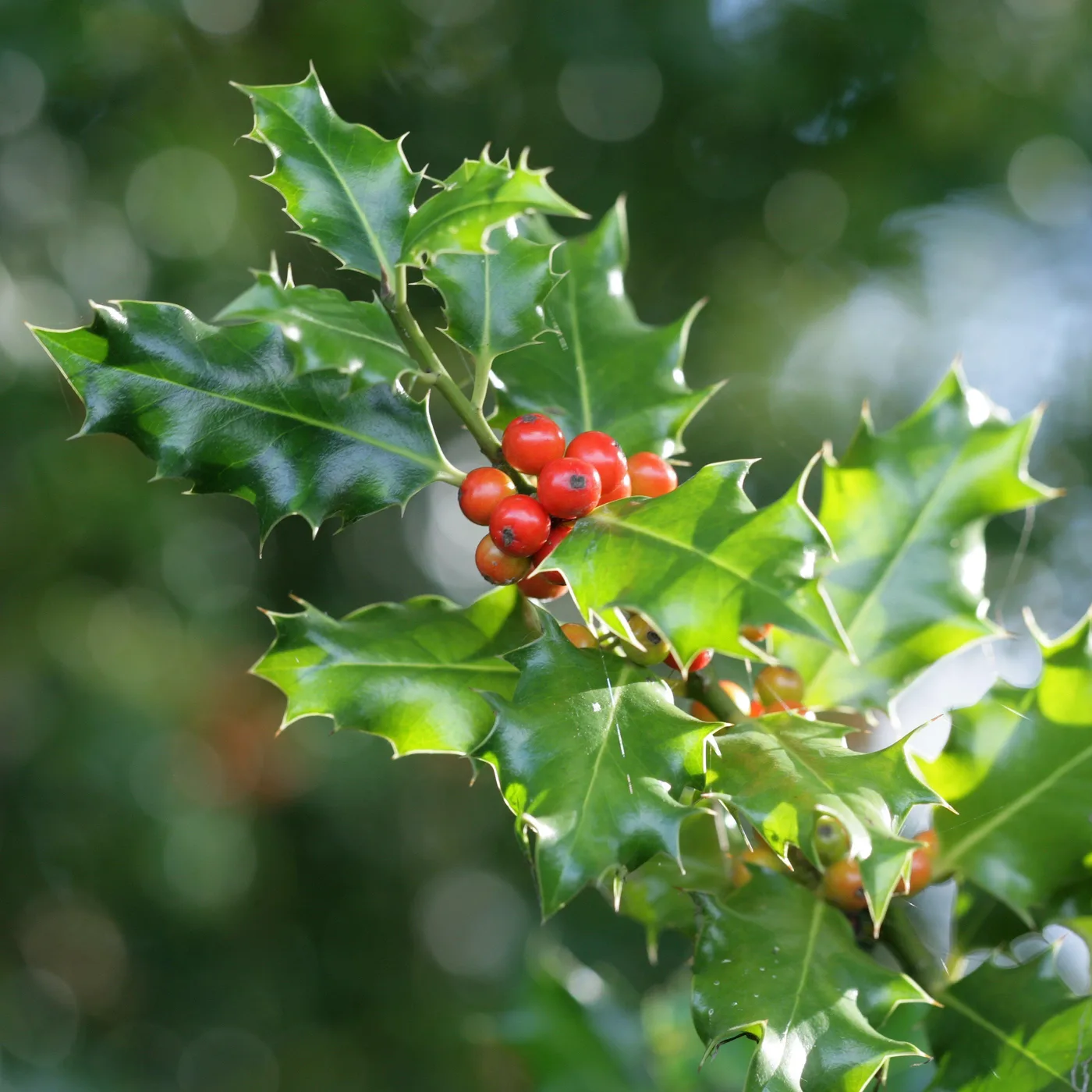
Red fruit can persist into spring, so cut after you have enjoyed it, because a hard winter clip takes the berries with it.
Keep the Pollination Plan Intact
China Girl is female, and fruit needs a male holly nearby. UConn lists China Boy as a pollinator for China Girl, reportedly hardy to -20°F. If you are training a standard for its berries, our guide to pollinating China Girl holly covers placement. Never remove the male to simplify the planting.
When the Same Plant Becomes a Clipped Cone
The same three-gallon shrub can take a second path. The first year is the same, but nearly everything after it differs.
Where the Paths Split
For a cone, you still pick a leader and you still remove the competitors, but you keep the lowest branches. A cone needs foliage down to the soil, so limbing up never happens and the stake is unnecessary. The lowest tier stays the widest, and each tier above it is clipped a little narrower, so the plant finishes at a point.
Clipping and Holding the Cone
Start with the leader, which you leave uncut until it reaches your chosen height. Then clip the sides from base to tip along a taper, always keeping the base wider than the top. A wider top shades the lower foliage and leaves bare patches that rarely fill back in. Dense China Girl takes this clipping well, which is why we suggest it for the topiary route. We often see cones turn thin at the base after a year of top-heavy clipping.
When the cone is established, switch to routine care. Our maintenance pruning guide covers the regular trimming that follows, so there is no need to repeat it here. UConn also notes that wholesale pruning is not necessary, which suits a form kept up with light, frequent clips.
What a China Girl Holly Standard Costs in Years
Now the totals. This section adds up the time, money and effort of the finished tree and sets them against the ready-made standard from the receipt.
The Tally for the Example
Here is what the three-gallon plan asks of you each year.
| Year | Work | Spend |
|---|---|---|
| One | Pick the leader, remove competitors, first lowest-tier cut | The three-gallon shrub |
| Two | Stake, tie, measure girth, second round of limbing | Stake and soft ties |
| Three | Set the clip height, round the head | Pruners, if you do not own them |
| Four | Retest the trunk, remove the stake, light clipping | Nothing further |
That is four years, a few quiet afternoons each winter, and two or three small receipts.
Training It Yourself or Buying a Trained Plant
The ready-made standard saves you four years and costs several times the price of the shrub. Training it yourself gives you the trunk height and head size you want, and the dollars saved are real. But you carry the risk. A damaged leader or a missed winter adds a year.
Our advice is simple. Train it if you can wait and want control. Buy one trained if the tree has to stand in a doorway next season.
Decide the Form Before You Pick Up the Pruners
The final tally for our example is four years and the price of one three-gallon shrub plus a stake and ties. Set that against the several-times-higher price of a ready-made standard, and the saving is clear. Choose your form before the first cut, because a standard needs a leader, patient limbing and a stake, while a cone needs the lowest branches kept and a steady taper. The two paths split immediately and cannot easily be swapped.
China Girl Holly
Nursery-grown China Girl Holly in sizes from 2 GALLON, shipped to your door.
From $87.99
Shop Now →Our growers watch China Girl through the year for fresh shoots on the trunk, leaf pests under the leaves and the weight of winter on a young head, and we grow and sell top-quality plants from our own farms.