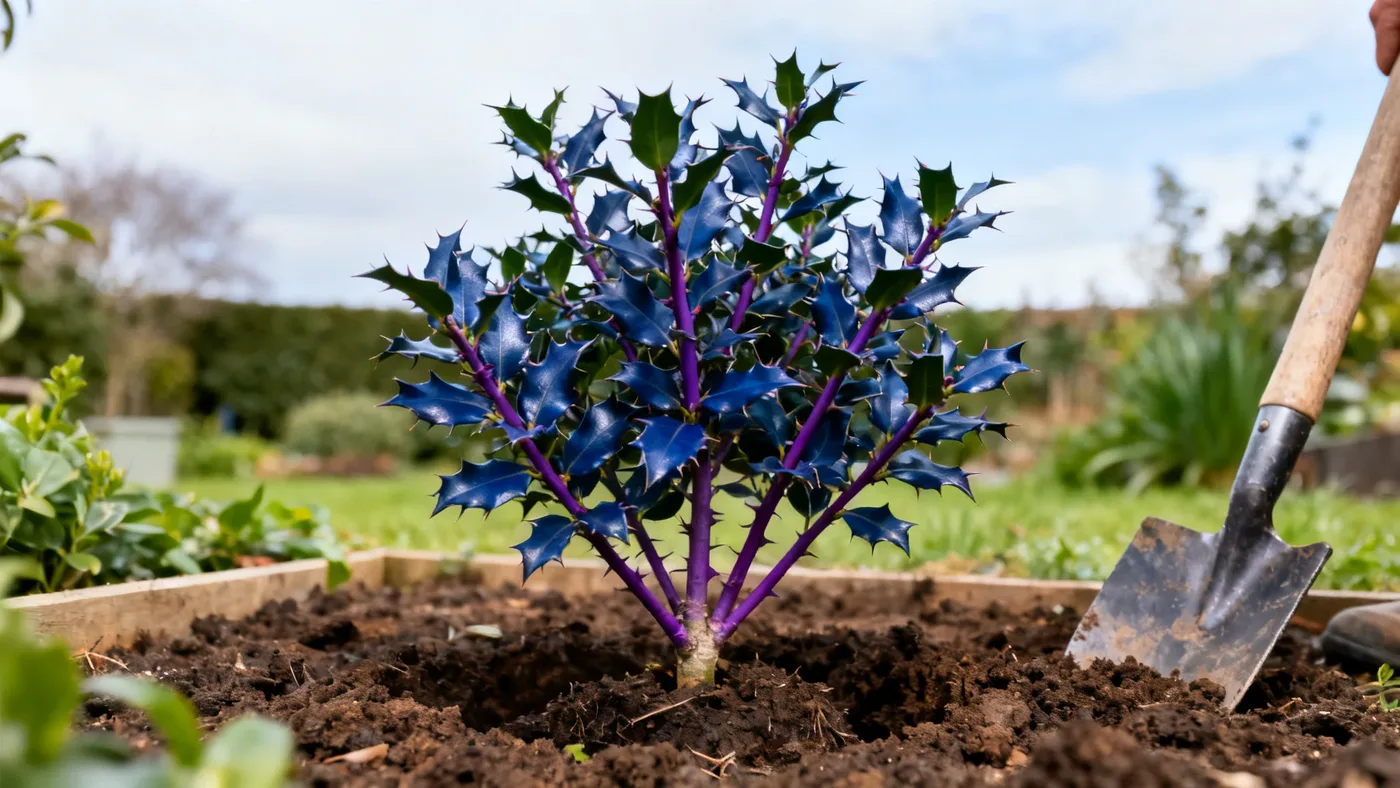
China Girl Holly Landscaping Ideas and Companion Plants
China Girl Holly is a versatile broadleaf evergreen shrub that earns its place in landscapes across zones 5 through 9. With glossy, dark blue-green foliage, spiny leaves, and brilliant red berries on pollinated plants, this hybrid holly works as a privacy screen, foundation anchor, or specimen focal point. The plant grows 8 to 10 feet tall and 6 to 8 feet wide at maturity, making it substantial enough to create real impact without overwhelming most residential gardens.
What makes China Girl Holly special is its adaptability. It tolerates coastal salt spray, poor drainage conditions better than many hollies, and even moderate deer pressure. But to get the best results, you need to think carefully about placement, spacing, and what plants to pair it with. This guide covers 10 practical landscaping applications, from hedges to mixed borders, so you can use China Girl Holly confidently in your yard or landscape design.
1. Create a Classic Privacy Hedge
A China Girl Holly hedge is one of the most effective ways to create year-round screening. Space plants 6 to 8 feet apart for dense coverage, and plan for them to reach 8 to 10 feet tall at maturity. Since this is a slow to moderate grower (roughly 6 to 12 inches per year once established), you'll wait a few seasons for full screening, but the payoff is evergreen privacy that holds its foliage all winter long.
For shaping, prune in late winter to early spring before new growth emerges. The plant tolerates hard shearing well, which means you can maintain a neat, formal hedge if that matches your landscape style. One caution: heavy pruning removes flower buds, so if you want winter berries, keep shearing moderate and time it after berries fade in late winter.
Practical takeaway: A single row of China Girl Hollies spaced 6 to 8 feet apart creates dependable privacy. Add a male pollinator like China Boy nearby for reliable berry production that adds winter visual interest.
2. Foundation Planting with Structure
China Girl Holly makes an excellent foundation plant because of its structured form and year-round presence. The 8- to 10-foot mature height works well at corners or as an anchor on larger homes, while the 6- to 8-foot width keeps it proportional to most residential foundations. Plant it in full sun for the densest foliage and most abundant berries, though it adapts to part shade if that's your site's reality.
Place the shrub far enough from the house to allow air circulation (at least 3 feet from the siding) and position it where water drains away from the foundation. The plant prefers well-drained, humus-rich soil, so amend the planting hole if your yard has heavy clay. Once established, it's moderately drought tolerant, which simplifies maintenance after the first year of establishment.
Practical takeaway: Use a single specimen at a corner or entryway, or flank a front door with a pair spaced 10 to 12 feet apart to allow mature width. This creates a classic, polished look year-round.
3. Windbreak for Exposed Sites
In zones where winter wind can desiccate foliage and damage tender plants, China Girl Holly serves double duty as both a visual screen and a protective windbreak. The glossy, spiny leaves shed wind more effectively than softer-leaved plants, and the dense branch structure provides real shelter for shrubs or perennials planted on the downwind side.
Site your windbreak on the exposed edge of your property, ideally with at least 3 to 4 hours of direct sun daily. Stagger multiple rows if wind exposure is severe, spacing plants 6 to 8 feet apart within rows and rows 4 to 5 feet apart. This creates a layered buffer that diffuses wind rather than creating an abrupt wall.
Practical takeaway: A windbreak of China Girl Hollies works best in zones 5 to 7, where winter wind stress is most damaging. Position it on the north or west side of your property to protect more tender plants.
4. Coastal Landscape Design
China Girl Holly is genuinely salt tolerant, making it one of the better holly choices for seaside gardens. It stands up to coastal salt spray and even tolerates some road salt exposure, which opens design possibilities in challenging waterfront and beachside environments. The plant thrives in zones 5 through 9, so it works across most U.S. coastal regions.
In coastal settings, pay attention to drainage after planting. Salt tolerance does not mean the plant wants soggy soil. Choose a well-drained site or amend heavy clay with sand and compost. Morning sun and afternoon wind are typical in these locations, which is actually ideal for China Girl Holly, as it promotes foliage density and berry production.
Practical takeaway: Replace tender, salt-sensitive hedging with China Girl Holly in coastal properties. You'll reduce maintenance stress and enjoy the same formal structure without the winter decline of less hardy alternatives.
5. Specimen Shrub for Year-Round Interest
Grown as a single specimen rather than massed or hedged, China Girl Holly becomes a focal point in any garden. Allow the plant 6 to 8 feet of space on all sides to express its natural form, and choose a location in full sun for the most robust growth and berry set. Late spring flowers are inconspicuous, but the dark evergreen foliage and bright red berries on pollinated plants create striking winter architecture.
Plant a male pollinator (China Boy is the traditional partner) within 50 to 100 feet to ensure reliable berry production. Without a male nearby, female plants like China Girl will flower but produce no fruit, losing half their seasonal appeal. This one detail separates a thriving specimen from an ordinary green shrub.
Practical takeaway: Plant a China Girl Holly specimen as an anchor for mixed perennial borders or in a prominent spot where winter berries matter. Include a China Boy male nearby, even if it's less visible, to guarantee the female produces its signature red fruit.
6. Hedging with Boxwood for Formal Gardens
China Girl Holly and Boxwood share a refined, formal aesthetic. Boxwood grows at a similar pace and tolerates shearing, so you can edge a China Girl Holly hedge with low clipped Boxwood to create layered, structured planting. The contrast between China Girl Holly's larger, darker leaves and Boxwood's fine texture adds visual depth without fussy maintenance.
Space plants according to their mature size: China Girl Hollies 6 to 8 feet apart as the backdrop, and Boxwood 2 to 3 feet in front. Both prefer well-drained soil and benefit from consistent moisture during establishment. In zones 5 and 6, choose cold-hardy Boxwood varieties, as some cultivars struggle with winter in the colder end of China Girl Holly's range.
Practical takeaway: Layer China Girl Holly and Boxwood to create a tiered hedge that looks intentional and sophisticated without excessive labor. Both respond well to pruning and hold their structure through winter.
7. Mixed Border with Azaleas and Rhododendrons
Azaleas and Rhododendrons are listed companion plants for China Girl Holly, and for good reason. All three prefer acidic to neutral soil (roughly 5.0 to 6.5 pH), so they share the same soil amendments and maintenance rhythms. Azaleas and Rhododendrons flower in spring, while China Girl Holly's berries peak in winter, so you get season-long color layering.
Plant China Girl Holly as the tall, structural backbone of the border (8 to 10 feet), with Rhododendrons at mid-height (4 to 6 feet) and Azaleas as low-growing accents (2 to 4 feet). Space them widely enough to avoid crown rot issues from poor air circulation: China Girl Hollies 6 to 8 feet apart, Rhododendrons 4 to 5 feet apart, and Azaleas 3 to 4 feet apart. For details on watering frequency and amounts, consult watering China Girl Holly: how much and how often.
Practical takeaway: Combine China Girl Holly with Azaleas and Rhododendrons for a mixed shrub border that offers structure, winter interest, and spring color in zones 5 to 7. This partnership minimizes fertilizing and pest problems compared to single-species plantings.
8. Container Growing for Flexibility
Young China Girl Holly plants sold in #3 containers can be grown in pots for a season or two before transplanting to the ground. This works well if you want to test a location, delay planting, or enjoy the shrub on a patio while it matures. Use a large pot with drainage holes, filled with well-draining potting soil mixed with peat moss to maintain acidity.
Container plants dry out faster than ground-planted specimens, so monitor soil moisture regularly. In zones 5 and 6, move the container against a house wall in winter or wrap it in frost cloth to protect the roots from extreme cold. For long-term success, plan to transplant container-grown plants to the ground within 2 to 3 years, as they won't reach their full potential (8 to 10 feet) in a pot indefinitely.
Practical takeaway: Container-grown China Girl Holly is ideal for patios, decks, or temporary screening while you finalize landscape plans. But treat potted plants as transitional; move them to the ground for long-term maturity.
9. Living Screen Between Properties
A living screen of China Girl Holly creates privacy and beauty between neighboring properties without the visual heaviness of a fence. Space plants 6 to 8 feet apart in a straight or staggered line, depending on your property line and site conditions. The slow to moderate growth rate (6 to 12 inches per year) means it takes 5 to 7 years to reach full screening height, but you gain a natural, softer alternative to hardscape.
Prune the tops lightly to encourage branching in early years, but don't shear heavily until the plants reach desired height. Once mature, minimal pruning maintains the hedge. The good deer resistance (the spiny leaves deter browsing) is a bonus if wildlife browsing is a concern in your neighborhood. For comprehensive growing guidance, see the complete growing guide for China Girl Holly.
Practical takeaway: Use a living screen of China Girl Holly to reclaim lost privacy and add seasonal interest. Plan for 5 to 7 years of maturation, then enjoy decades of dependable screening with minimal maintenance.
10. Pairing with Japanese and Inkberry Hollies
Japanese Holly (Ilex crenata) and Inkberry Holly (Ilex glabra) are commonly confused with or compared to China Girl Holly, but they're distinct plants worth coordinating with. Inkberry Holly shares China Girl Holly's salt tolerance and coastal suitability, while Japanese Holly offers finer texture for contrast. All three prefer acidic soil and tolerate part shade, so they work well together in mixed plantings.
Combine them by letting each species express its natural character: China Girl Holly as the tall, structural element; Inkberry Holly at mid-height for visual layering; and Japanese Holly as a fine-textured accent. Space generously according to each plant's mature width (6 to 8 feet for China Girl, 4 to 6 feet for Inkberry, and 2 to 4 feet for Japanese), and water consistently during establishment.
Practical takeaway: Mix China Girl Holly with related holly species to create diverse, resilient landscapes that showcase each plant's strengths without competing for space or care.
Quick Reference: China Girl Holly Landscaping Checklist
| Landscaping Use | Spacing | Sun Requirement | Mature Size | Best Zones |
|---|---|---|---|---|
| Privacy hedge | 6-8 ft apart | Full sun ideal | 8-10 ft tall, 6-8 ft wide | 5-9 |
| Foundation planting | 10-12 ft between pairs | Full sun to part shade | 8-10 ft tall, 6-8 ft wide | 5-9 |
| Windbreak | 6-8 ft apart, staggered rows | Full sun (3+ hours daily) | 8-10 ft tall, 6-8 ft wide | 5-7 |
| Coastal planting | 6-8 ft apart | Full sun | 8-10 ft tall, 6-8 ft wide | 5-9 |
| Specimen shrub | 6-8 ft clearance all sides | Full sun | 8-10 ft tall, 6-8 ft wide | 5-9 |
| Mixed shrub border | 6-8 ft from other plants | Full sun to part shade | 8-10 ft tall, 6-8 ft wide | 5-9 |
| Container growing | One plant per large pot | Full sun | 4-6 ft (limited potted) | 5-9 (protect in cold zones) |
| Living screen | 6-8 ft apart | Full sun ideal | 8-10 ft tall, 6-8 ft wide | 5-9 |
| With Boxwood edging | 6-8 ft (Holly), 2-3 ft (Boxwood) | Full sun to part shade | 8-10 ft Holly, 1-3 ft Boxwood | 5-9 |
| With Azaleas/Rhododendrons | 6-8 ft Holly, 4-5 ft Rhododendron, 3-4 ft Azalea | Full sun to part shade | 8-10 ft Holly, 4-6 ft Rhododendron, 2-4 ft Azalea | 5-9 |