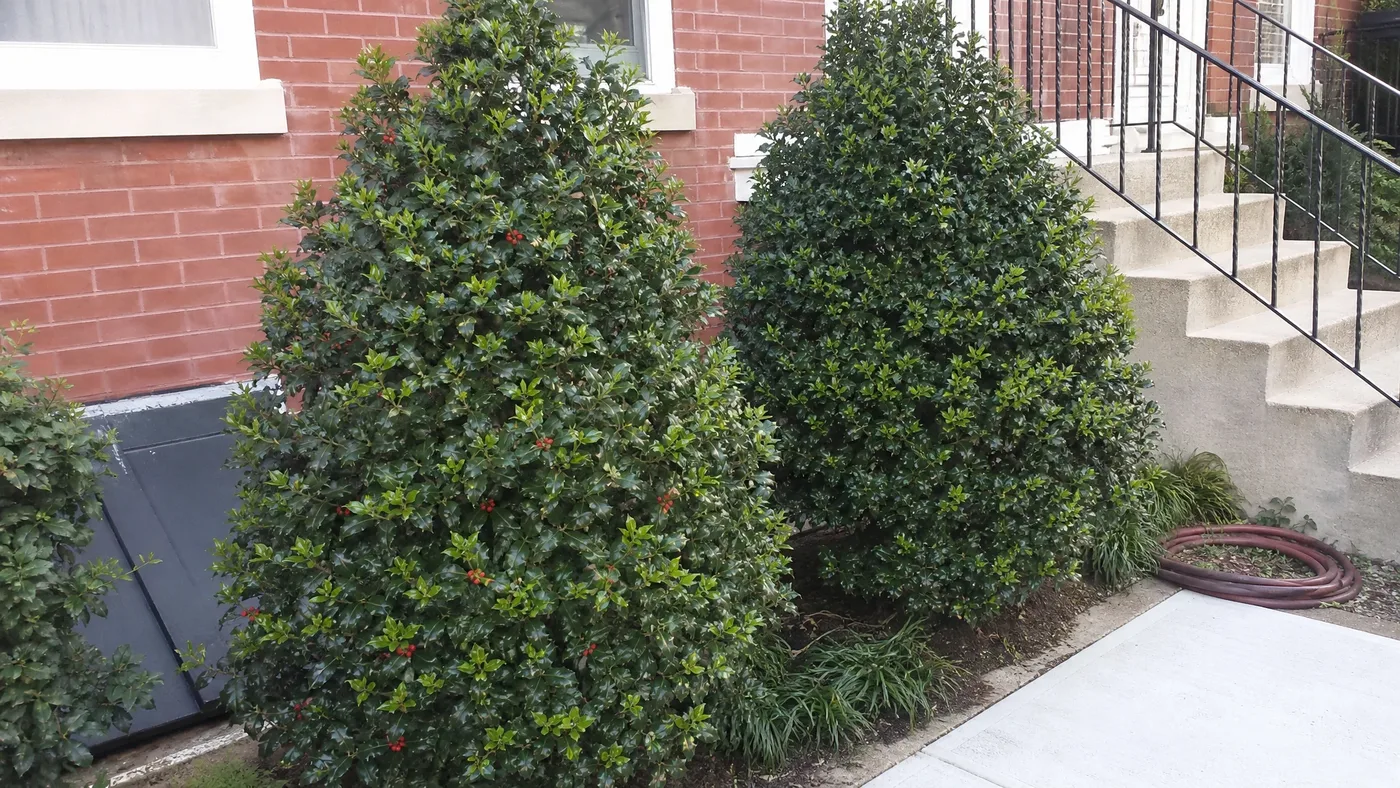
China Boy vs China Girl Holly: Key Differences
Late in spring, stand beside a pair of hollies in bloom and watch the bees. They work the blossoms on one plant for minutes at a time while its neighbor, a few feet away, barely draws a visit. Two numbers matter when you choose between them. Ten feet is how tall and wide each one can grow, and one is how many of the pair ever carries a berry.
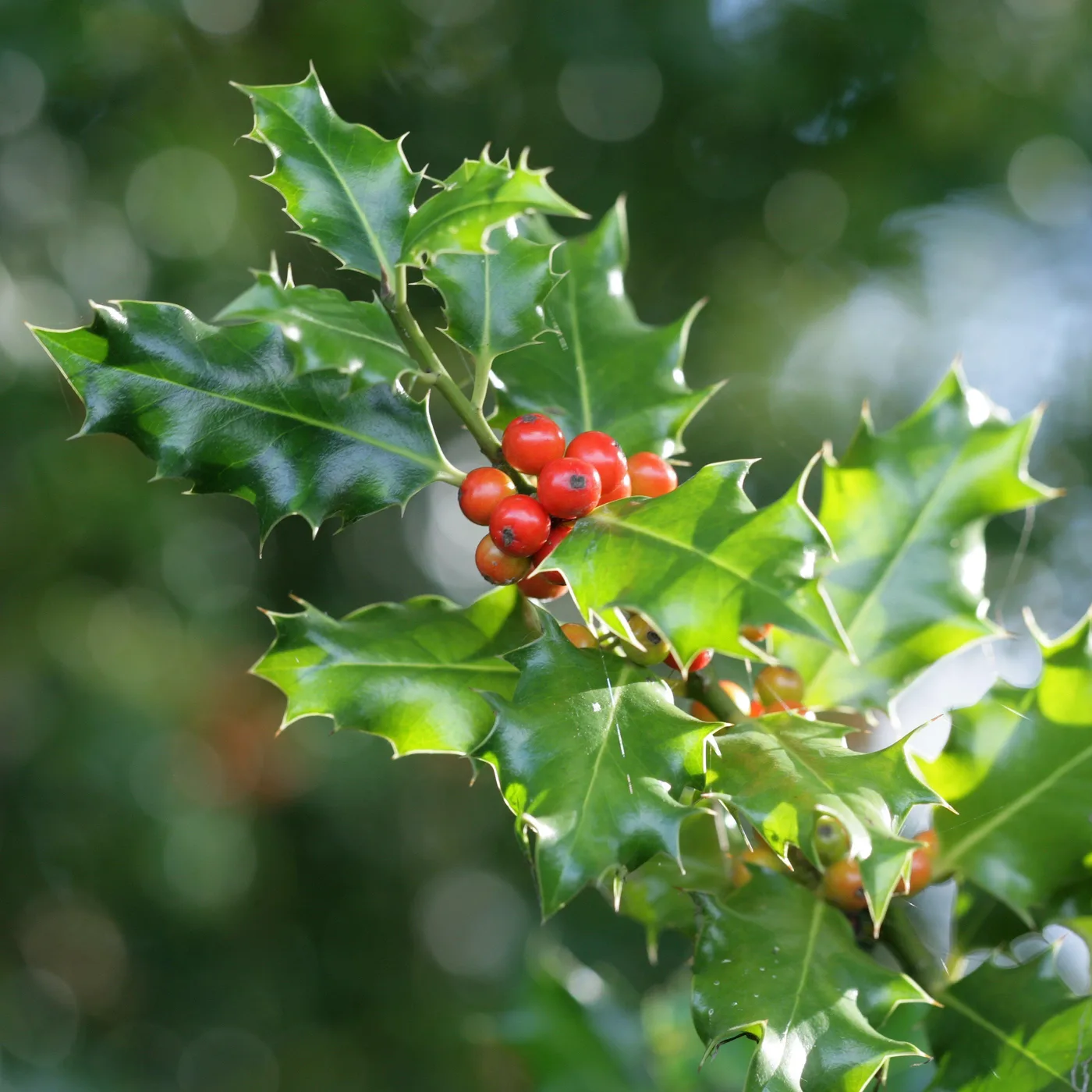
China Boy and China Girl are sold as a matched set, and buyers often treat them as interchangeable. Buy two females and you get bare-looking green with no fruit. Buy two males and the berries never come. We'll walk you through the berry question first, then leaf and form, size and placement, what each plant gives birds and bees, how close the two must stand, and how many of each to buy.
Which Holly Carries the Berries You Want
Every other choice in this guide follows from one question: do you want fruit? The two plants answer it differently, and only one of them ever pays you back in red.
Only the Female Fruits
Oregon State's landscape plant listing names China Girl as the female ('Mesog') and China Boy as the male pollenizer ('Mesdob') of the Meserve holly group. Fruit forms only on female plants, so China Boy will never carry a single berry, however well you grow it.
Both sexes flower. The blossoms are small and white to pinkish-white, opening in spring. What differs is what happens next: China Girl sets fruit only where pollen from China Boy has reached her flowers, and the red fruit then holds from fall into spring.
What China Boy Is Really For
UConn calls China Boy a male selection useful as a pollinator for China Girl, and that is the whole job description. It supplies pollen and evergreen structure, nothing more. If berries do not matter to you, either plant is a fine evergreen alone. If they do, you need both, or a male growing close by.
When a Holly Never Berries
One of the most common questions we get is whether a China Girl that has never fruited has something wrong with it. Usually the plant is fine. Work through these checks in order:
- Read the tag or your purchase record. A plant sold as China Boy will never fruit, and unlabeled hollies are easy to mix up after a year or two.
- Look for a male within bee range. With no China Boy or other compatible male nearby, the flowers open and fade without setting fruit.
- Allow for age. Meserve hollies have a slow growth rate, so a young plant is small and carries few flowers to pollinate.
If berries matter to you, buy China Girl as the lead plant and treat China Boy as the partner that makes her work.
Foliage Differences Between China Boy and China Girl Holly
This is the part buyers expect to be easy, and it is not. The table puts the published descriptions side by side so you can see how little separates the two in leaf and form.
| Trait | China Girl ('Mesog') | China Boy ('Mesdob') |
|---|---|---|
| Sex | Female | Male (pollenizer) |
| Berries | Large red winter fruit | None |
| Foliage | Dark, glossy, prominently spine tipped | Glossy green |
| Habit | Compact, upright-rounded | Rounded and dense |
| Mature size | About 10 feet tall and wide | About 10 feet tall, similar spread |
| Role | Berry-bearing plant | Pollen source |
What the Leaves Tell You
Not much, which is the honest answer. Both plants carry the dark, glossy evergreen foliage of the Meserve hollies, and the group has blue-green leaves.
China Girl's leaves are prominently spine tipped. The China Boy descriptions we rely on say glossy green and do not make a point of spines. We would still handle both with gloves, because holly leaves are sharp enough that you will not enjoy guessing.
Form Is Closer Than You Have Heard
You may read that China Boy is the narrower, more upright plant and China Girl the denser pyramid. We would not lean on that. China Boy's habit is rounded and dense, and China Girl is compact, upright-rounded. Those are near twins.
Light, soil and pruning change a holly's outline more than its sex does. The species itself ranges from vase-shaped to rounded, so a silhouette across the yard proves nothing.
How to Tell Them Apart
Three methods work, and none depends on shape. Use them in this order:
- Stake a label at planting and keep the plant tags in a drawer. This beats every other method.
- Look for fruit in fall once a pair has been together for a season. Berries mean China Girl, and a plant that never fruits beside one that does is the male.
- If the label is lost, go back to the seller's record of what you bought and when. A written record settles it faster than any guess in the yard.
Decide by label and fruit, never by silhouette.
How Tall Each Plant Will Stand in Your Space
Size is where the cultivars part ways with their species. Plan with the cultivar numbers below, not with the figures printed for Meserve holly in general.
What the Numbers Say
Cornell lists China Girl as a shrub that grows to 10 feet tall and wide. UConn gives China Boy about 10 feet tall with similar spread. The species, by comparison, typically reaches 3 to 8 feet tall and 6 to 8 feet wide.
Sources do not all agree. Growth is slow, so you may not see 10 feet for a long time. Our China Girl size guide covers the rate in more detail, and your local extension service can tell you what holds in your climate.
Planning the Pair's Footprint
Two shrubs that each reach about 10 feet across will fill a bed roughly 20 feet long once they meet. For centers and gaps, our spacing guide works through the arithmetic.
Their site needs match, so one bed can serve both. Meserve holly does best in average, slightly acidic, moist, well-drained soil in full sun to part shade. If leaves yellow, check the soil pH and drainage before you reach for fertilizer, and see our soil guide for the fixes.
Placement Choice
Give China Girl the place where the room is generous and the view is good, because she is the plant you will look at in winter. Set China Boy to the side or behind, where it fills out the planting and supplies pollen without taking the front. If you only have room for one shrub, make it China Girl and look for a male nearby.
What China Girl Holly Offers Birds and Bees
The two plants feed wildlife at different times of year, and that split should decide where each one goes.
Blossoms That Feed the Bees
The flowers are small and white to pinkish-white, and they open in spring. Both plants bloom, so both are in play when insects arrive. China Boy's part is the pollen, and the insects that carry it are what turn China Girl's flowers into fruit.
This is why the scene at the start of this guide matters. A bee does not care about our labels, but its routes decide which flowers set berries.
Red Fruit and Evergreen Cover
China Girl's large red fruit is the main interest of the plant, and it holds from fall into spring. In our rows, the first birds show up at the fruit once cold weather sets in. Fruit hanging in a bare season is the point of owning a female holly at all.
The dense evergreen foliage gives cover as well, and the spine-tipped leaves make a thorny retreat. Read our deer and rabbit guide before you count on the spines. The plant has low severity poison characteristics.
Where to Site the Berried Plant
Put China Girl where you can watch the fruit from a window or a path you use in winter. China Boy gives wildlife shelter but no fruit, so it can sit where the view matters less. The visitors will show you which plant is which long before any tag does.
Pairing Distance for China Girl Holly and Its Mate
Pollen moves by insect, and insects make short hops. That makes distance the next decision, and it is simpler than most buyers fear.
Why Bees Set the Limit
None of our sources gives a distance in feet, and we will not invent one. Check with your local extension service if you want a number for your area. Our pollinator guide covers the mechanics in full.
Customers usually ask us whether a neighbor's male holly counts. It might, but you cannot prune, move or replace a plant you do not own. If the neighbor removes it, your berries go with it.
The Distance We Recommend
Plant China Boy in the same bed as China Girl, close enough that the two shrubs touch at maturity. With a spread of about 10 feet each, that means two plants set in one planting rather than on opposite sides of the property. A pair in one bed also shares watering and soil, which makes both easier to look after.
If your layout forces a gap, keep it as short as you can and keep the plants in view of each other. Our choice is the same bed, side by side.
Settling the Ratio of Females to Males
The last decision is how many of each to buy. The answer depends on whether you are planting a pair or a row.
For a Single Pair
Buy one China Girl and one China Boy, planted together. That gives you berries from the first year both are flowering, and it leaves you with the same pair this guide has compared. Choose plants of similar size, because a small male beside a large female may have too few flowers to pollinate her well.
For a Hedge or Screen
A single male can serve several females, since every female needs only a pollen source within reach. Our sources do not give a ratio, so ask your extension service for one that fits your row. Set the males inside the row rather than at one end, so the far end of the hedge is not left out.
We would also consider a spare male. If your only China Boy dies, the berries on every female in the row stop, and a replacement starts small. Whatever the count, buy more females than males, because the females are the plants you came for.
China Girl Holly Leads, China Boy Follows
The choice a buyer finishes with is simple: China Girl as the berry-bearing lead plant, with China Boy planted close beside it as the pollen source. Tell them apart by label and fruit, give them the same bed, and size the space for 10 feet of each. In winter, the birds visiting the red fruit will show you that the pairing worked.
China Girl Holly
Nursery-grown China Girl Holly in sizes from 2 GALLON, shipped to your door.
From $87.99
Shop Now →Customers keep coming back to us for China Girl and China Boy that arrive matched to their tags, because a pair only works when each plant is the sex you expect. Our own farms and our small business are built around growing top-quality hollies, and this pairing is one we know well.