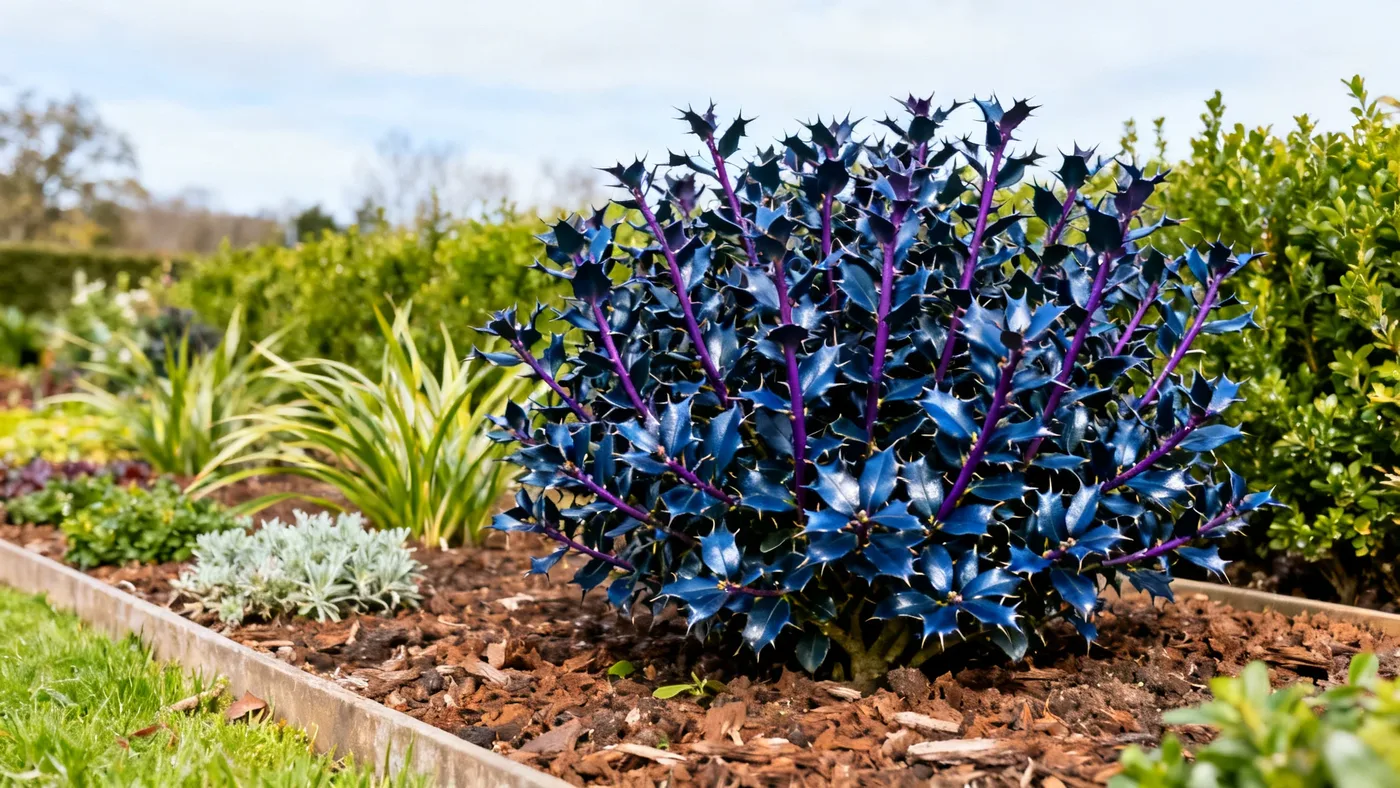
China Girl Holly Spacing for Hedges and Privacy Screens
The difference between a loose, gappy hedge and a tight, professional-looking privacy screen often comes down to one simple decision made before you dig the first hole: spacing. Plant China Girl Holly too far apart, and you'll wait years for the shrubs to fill in, or worse, end up with permanent gaps. Plant too close, and you'll waste money, create disease problems, and spend the next decade fighting overcrowding. The right spacing depends on your zone, your timeline, and what you're actually trying to screen.
What You'll Need
- China Girl Holly shrubs in #1 or #3 containers (most common retail sizes)
- Measuring tape or a marked measuring stick
- Landscape marking paint or stakes and string
- Shovel and digging fork
- Well-drained soil amendment or compost (if your native soil is heavy clay or compacted)
- Mulch (wood chips or composted bark, 2 to 3 inches deep)
- Watering can or soaker hose
Understanding China Girl Holly Growth Before You Space
China Girl Holly reaches a mature height of 8 to 10 feet and a mature width of 6 to 8 feet over roughly 10 to 15 years. That's the baseline. However, the plant grows at a slow to moderate rate, roughly 6 to 12 inches per year once established. This means a 2-foot shrub from your nursery won't hit 8 feet overnight.
Why does this matter for spacing? Because the spacing you choose now determines whether your hedge will look full at year five (when you'll start noticing it from the street) or whether it will hit full density only at year 15. Most home gardeners and landscapers want meaningful screening within 5 to 7 years, not decades.
Also, China Girl Holly tolerates pruning well. You can shear hedges to maintain a tighter width than the natural 6 to 8 feet. This gives you flexibility: you can plant closer if your space is tight and keep the hedge narrower through regular shearing. But you cannot make a sparse planting grow faster; once the plants are in the ground, your spacing decision is final.
The Spacing Standard for Hedges and Screens
For China Girl Holly hedging and screening, space plants 6 to 8 feet apart (center to center) along a line. This is the industry standard for a reason.
Here's what that spacing gives you:
- At 6 feet apart: Tighter fill-in, faster visual screening (5 to 6 years to a dense hedge with regular pruning). Use this spacing if your space is generous and you want a professional privacy screen sooner.
- At 8 feet apart: More room for individual plants to grow, less aggressive pruning needed to maintain width. Use this spacing if you prefer a more natural, less-sheared appearance or if your budget is tighter (fewer plants per linear foot).
- Between 6 and 8 feet: A middle ground. Many landscapers use 7 feet as a practical compromise.
Do not space closer than 6 feet. Overcrowding increases disease pressure, reduces air circulation, and requires heavy pruning that removes flower buds and that year's berry set. The spiny foliage will also become matted rather than glossy.
Do not space wider than 8 feet for a hedge intended as a privacy screen. You'll have visible gaps for 8 to 10 years, and the finished hedge may never feel fully dense.
Step-by-Step Planting Instructions
1. Mark your line and spacing points.
Run a string line along where your hedge will go. Use landscape marking paint or wooden stakes to mark each planting spot at 6-foot (or 7-foot or 8-foot) intervals. Double-check distances with your measuring tape. A few inches of error per plant adds up over a 50-foot hedge.
2. Dig each planting hole.
Dig a hole as wide as the root ball and just as deep, or slightly shallower. The top of the root ball should sit level with the ground or 1/4 inch above grade. Sitting too deep is one of the most common mistakes and invites root rot. China Girl Holly prefers well-drained soil, and sitting low traps water around the crown.
3. Amend the backfill if needed.
If your soil is heavy clay or compacted, mix in compost or a soil amendment to the native soil you'll use to backfill. A 25 to 50 percent amendment by volume is sufficient. China Girl Holly adapts to loam, clay, or sandy soil as long as drainage is decent. You're not replacing the soil; you're just improving the immediate planting zone.
4. Set each shrub in the hole.
Loosen the root ball gently. If the shrub is root-bound, make 3 or 4 gentle score marks down the sides of the root ball with a shovel edge to encourage outward root growth. Set the shrub in the hole and backfill, tamping gently as you go. Avoid air pockets, but do not compress the soil so hard that water cannot drain.
5. Water thoroughly at planting.
Water each shrub deeply right after planting, even if the soil is moist. This settles the backfill and closes air gaps. Aim for water that soaks down 6 to 8 inches.
6. Apply mulch.
Spread 2 to 3 inches of wood chips or composted bark around each shrub, keeping the mulch 2 to 3 inches away from the stem to avoid rot. Mulch retains soil moisture and moderates soil temperature, which helps newly planted shrubs establish roots faster.
7. Water regularly for the first year.
Water every 2 to 3 days for the first 2 weeks, then scale back to once per week through the first growing season if rainfall is sparse. Once established, China Girl Holly is moderately drought tolerant, but regular watering (1 inch per week) during dry spells keeps the hedge full and glossy. Consistent moisture also reduces pest and disease stress.
Timing Your Planting
Plant China Girl Holly in early spring or early fall to allow root establishment before temperature extremes. Early spring (March to April in zones 5 to 7, earlier in zones 8 to 9) and early fall (August to September) are ideal. Avoid planting in hot summer or deep winter.
If you're planting a large hedge, stagger the work over two or three weekends in the same window. The shrubs will establish more consistently if they're not all in the ground on a single hot day.
Tips and Common Mistakes
Don't assume shelter equals less spacing. Some gardeners plant closer in windy sites, thinking they need a thicker hedge for wind protection. In reality, China Girl Holly tolerates coastal conditions and salt spray well, and proper spacing with healthy, vigorous growth is better than crowding stressed plants. Adequate spacing reduces disease, which matters more than an extra half-foot of foliage.
Don't skip the measuring tape. Eyeballing spacing often leads to a hedge where plants 1, 3, and 5 are at 6 feet but plants 2 and 4 are at 5 feet and 7 feet. Inconsistent spacing shows up visibly once the hedge is established. Spend 10 minutes with a tape now and avoid a 15-year regret.
Don't plant tighter to speed up fill-in. The plants themselves grow at 6 to 12 inches per year, regardless of how many neighbors they have. Overcrowded plants grow slower, not faster, because they compete for light, water, and nutrients. You get a dense hedge eventually, but you pay for it in stunted plants and pruning work.
Consider your male pollinator. China Girl Holly is a female cultivar and produces berries only with a nearby male pollinator, such as China Boy. If berry production matters to you for fall and winter interest, plant a male every 8 to 10 feet in or near your hedge. If berries are not a priority, spacing is purely about density and aesthetics.
Plan for pruning access. A hedge needs room to work. If your hedge is against a fence or wall, leave 18 to 24 inches behind it for pruning access. This also improves air circulation and reduces fungal issues.
Expected Results at Key Milestones
Spacing at 6 to 8 feet apart, with regular watering and care, you can expect a China Girl Holly hedge to perform roughly as follows:
Year 1 to 2: Plants establish, little visible fill-in. The shrubs will grow 6 to 12 inches per year on average. Gaps remain obvious.
Year 3 to 5: Noticeable fill-in occurs. Branches begin to interweave. If you are spaced at 6 feet, the hedge may appear fairly dense by year 5 with light pruning. At 8 feet, gaps are still visible but narrowing.
Year 7 to 10: Solid, professional-looking privacy screening for most spacings. Individual plants are no longer obvious; the hedge reads as one continuous line. At year 10, regular shearing maintains shape and density.
Year 15+: Full mature width (6 to 8 feet) and height (8 to 10 feet, or taller if left unpruned). The hedge requires annual or semi-annual pruning to keep it tidy and to maintain the width you want.
For more details on pruning, fertilizing, and long-term care once your hedge is established, see the China Girl Holly care guide.
Quick Reference: Spacing Checklist
| Factor | What to Do |
|---|---|
| Spacing distance (center to center) | 6 to 8 feet. Use 6 feet for faster density, 8 feet for wider spacing and fewer plants per linear foot. |
| USDA zones | China Girl Holly grows in zones 5 to 9. Check your zone before planting. |
| Planting season | Early spring or early fall. Allows root establishment before temperature extremes. |
| Planting depth | Hole as wide as root ball, just as deep or slightly shallower. Top of root ball level with grade or 1/4 inch above. |
| Sun exposure | Full sun to part shade; full sun gives best density and berry production. |
| Soil | Well-drained, humusy. Adapt to loam, clay, or sandy soil; avoid waterlogged sites. |
| Watering first year | Every 2 to 3 days for first 2 weeks, then weekly if rainfall is sparse. Once established, 1 inch per week during dry spells. |
| Mulch | 2 to 3 inches wood chips or bark, 2 to 3 inches away from stem. |
| First visible density | Year 5 to 6 with regular pruning (spacing at 6 feet). Year 8 to 10 at 8-foot spacing. |
| Full mature height and width | 10 to 15 years. Height 8 to 10 feet (or taller unpruned). Width 6 to 8 feet (maintained via pruning). |
| Expected growth rate | Slow to moderate, roughly 6 to 12 inches per year once established. |
| Male pollinator (for berries) | Optional. Plant one male (China Boy) every 8 to 10 feet if berries are desired. |