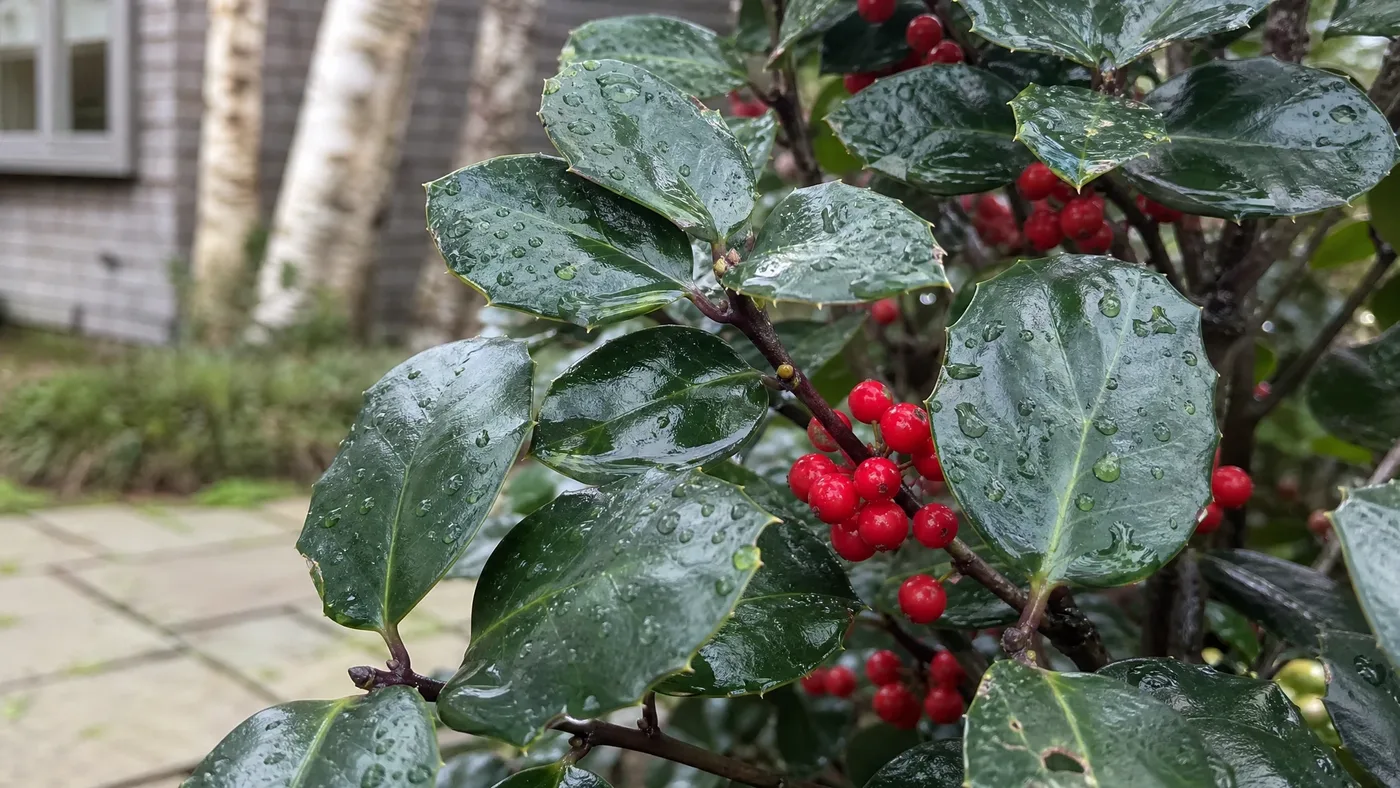
China Girl Holly Leaf Identification: Shape, Spines and Color
You are standing in a nursery parking lot, squinting at a bench of unlabeled green shrubs from thirty feet away, trying to work out which one is the holly you came for. Most of them are evergreen, most are dark, and a tag stuck in the wrong pot is easy to miss.
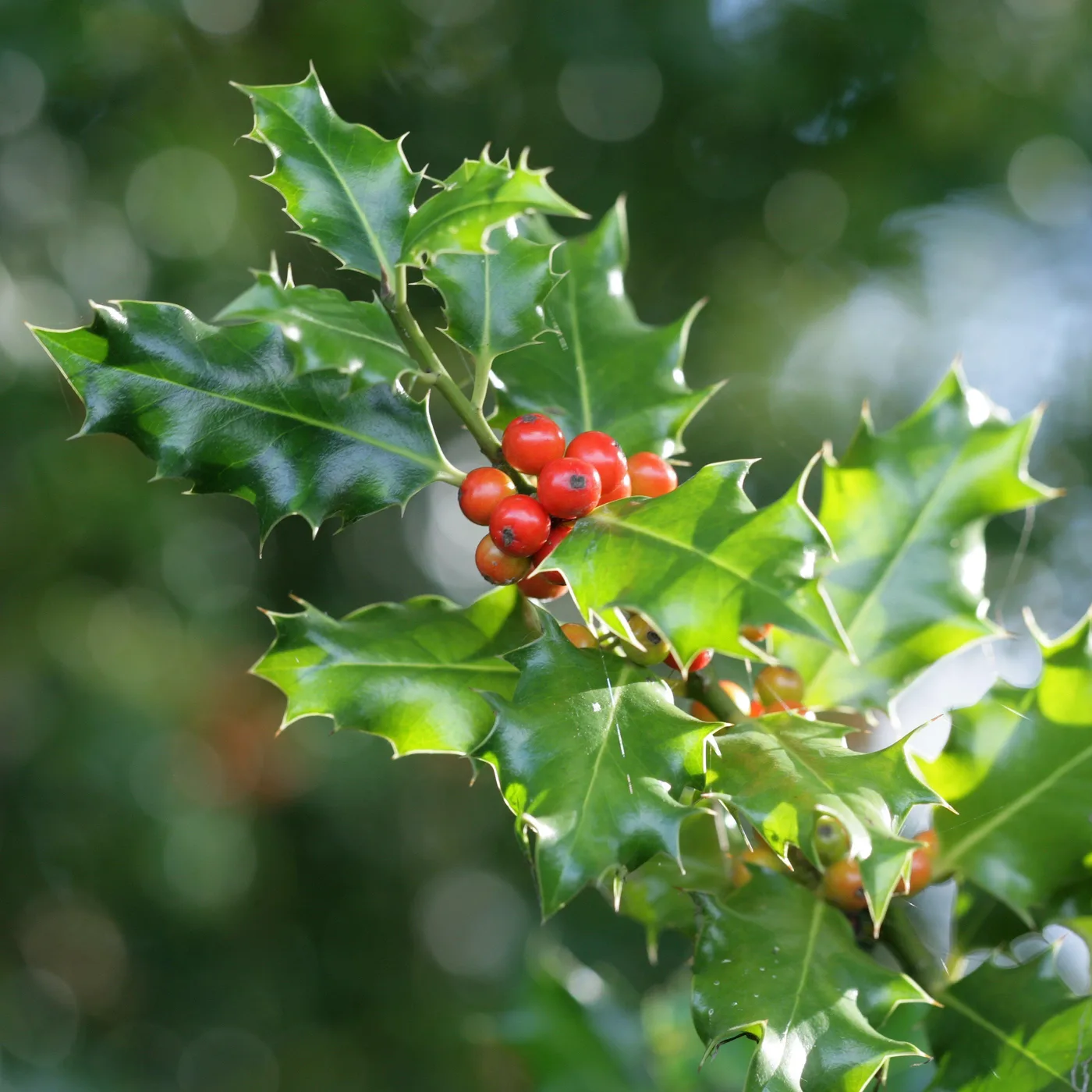
China Girl is a Meserve hybrid holly, and it has a look you can learn in a few minutes. Get it wrong and you may plant a larger, spinier holly, or a male plant that never carries a berry. Get it right and you know exactly what is going into your yard.
This article talks about China Girl's overall shape, leaf, spines, color and berries and answers the questions customers ask us most. Read on to learn how to confirm the cultivar from across the yard, then from one branch, then from a single leaf in your hand.
China Girl Holly Seen Across the Whole Yard
Start with the widest view, because a mature China Girl announces itself before you can see a single leaf. Here is what the whole shrub should look like from the sidewalk.
Cornell lists the cultivar at 10 feet tall and wide, so a mature plant is a full, rounded mass about as broad as it is high. The species runs smaller, typically 3 to 8 feet tall, so a big, wide shrub is the cultivar showing its own character.
The hybrid is also given a smaller figure of about 6 feet, a good reminder that size depends on age and site. Our China Girl size guide covers the growth rate in detail.
The Color Reads Dark
Color is the second thing you notice, and it matters more than most buyers expect.
The foliage is a deep, glossy green. The glossy surface throws light back, so the whole mass looks polished rather than dusty, and sun picks out bright highlights on the outer leaves. Compare that with American holly, which has dull, dark green leaves. Dull and glossy are easy to tell apart from thirty feet away.
What Stays Put All Year
China Girl is evergreen, so the silhouette and tone do not change between January and July.
The one seasonal change is the fruit. On a female plant, red berries ripen in fall and can persist into spring, which gives the dark mass a scattering of red. If you see a plain dark mound in December, keep that in mind for the last sections.
Reading China Girl Holly's Shape at Arm's Length
Take a few steps in until you can see the branching but not yet the leaf edges. At this distance you are judging habit and density.
The Bartlett Arboretum describes the cultivar's habit as compact and upright-rounded, and calls it very heat-tolerant. The hybrid group varies from vase-shaped to rounded, so a vase-shaped plant with an open, hollow center should make you pause. A true China Girl fills in toward the middle, with leaves reaching down close to the base of the shrub.
The Light-Through-the-Center Test
This is the check we tell customers to try first, and it takes ten seconds.
Look at the shrub with the sun or sky behind it. A dense plant blocks most of the light, and you see leaves overlapping on every side. If you can see through to the opposite side in large patches, the plant is either young, stretched, or something other than China Girl.
Allow for Age and Slow Growth
Do not expect a nursery plant to look like the mature picture.
Hybrids in this group have a slow growth rate, so a young plant is small and may look a bit open while its branching builds. Judge the direction of the habit, rounded and tightening, not the finished size. A young plant that is already lopsided or very sparse deserves a closer look at the roots and the label.
Line several plants up side by side if you can. Plants of the same cultivar from the same batch should match each other in leaf tone and branching, so the odd one out on the bench is the first to question.
One Branch of China Girl Holly in Hand
Now take hold of a single branch. Choose one from the outside of the shrub, about as long as your forearm, so you can see how the leaves are arranged along the stem.
How Leaves Sit Along the Stem
Run your eye down the branch from the tip back toward the trunk.
Leaves attach one at a time, staggered along the stem rather than in opposite pairs, and they are crowded closely enough that the stem is hard to see. That close spacing is what builds the dense look from a distance. A branch with long bare stretches between leaves points to a thin plant, usually from low light or poor feeding.
What New Growth Looks Like
New growth shows up at the branch tips in spring, and it is the easiest place to see how this plant is put together.
The fresh leaves are softer than the older ones and may look a little lighter before they harden and darken. Even so, they already carry the cupped margins and small spines described below, so you can use a new tip to confirm the plant before the leaves mature.
If new growth is pale and the older leaves are yellowing, the cause is usually in the soil, not the cultivar. We cover that fix in our soil guide.
Outline and Gloss on a Single Leaf
Pick one mature leaf from the middle of a branch and hold it flat in your palm. Everything below can be checked in about a minute.
Shape and Size
The first thing to read is the outline and the measurements.
Meserve hybrid leaves run 1 to 2½ inches long and 0.75 to 1.25 inches wide, with a leathery texture. Expect an oval to elliptical leaf, widest around the middle and tapering to a point.
That is small for a holly. American holly leaves run 2 to 4 inches long, so a leaf near the top of that range does not belong to this plant.
The Cupped Margin
Look at the edge of the leaf from the side, not from above.
UConn notes that the margins of China Girl and its male counterpart turn under, giving a cupped look that separates them from the Blue hybrids. A leaf that lies perfectly flat is a reason to doubt the tag. A leaf with a slight downward curl along both edges is a good sign.
Gloss and Color Problems
The surface should be glossy and a deep green, with no mottling.
If a leaf is dark and shiny on top but the plant looks washed out overall, check the soil. Hollies like slightly acidic, moist, well-drained ground, and pale yellow foliage is the usual sign that the pH is off or the roots are sitting wet. That is a growing problem rather than a different cultivar. Our guide to common China Girl problems walks through the other causes.
Counting the Sparse Spines on China Girl Holly
This is the check that separates China Girl from the larger hollies it gets confused with. Counting is more reliable than judging by feel, so use a set method.
Meserve hollies have spines that are flexible and almost rubbery. That gives you the picture: small, bendy points rather than the stiff teeth of American holly.
Written descriptions differ on how many spines to expect, so trust your own count over any one line.
How to Count
Count on a mature leaf from the middle of the branch, not a soft new tip and not an old, battered leaf.
- Hold the leaf flat and look at one edge, from the base to the tip.
- Count each point along that edge, then do the other edge.
- Repeat on four or five more leaves from different branches.
Spine counts vary from leaf to leaf, so the average matters more than any one leaf. On China Girl, the points are few and small compared with an American or English holly leaf.
Reading the Result
One of the most common questions we get is whether a smooth leaf means the plant is mislabeled.
Not by itself. A few smooth leaves on an otherwise pointed plant are normal. What should worry you is a plant where every leaf has large, stiff teeth all the way around, or a plant where none of the leaves have any points at all. Those are the patterns that point to a different holly.
Where China Girl Holly Hides Its Berries
The last check is the smallest, and it is the one buyers overlook. The fruit sits tight against the stem, under the leaves.
Finding the Fruit
Look at the leaf axils, the angle where each leaf joins the stem.
UConn describes China Girl as a female clone with abundant 1/3 inch red fruit, about the size of a small pea. The berries ripen in fall and press against the stem, so you may only see them when you lift a branch and look underneath.
They follow small white to pinkish-white flowers that open in spring, so a plant in bloom is a plant that can still set fruit later in the year.
What a Bare Plant Tells You
No berries does not always mean a wrong plant, so check the possibilities in order.
Berries appear only on female plants, and females need a male in the vicinity to set fruit. A young plant, a plant with no male nearby, or a plant checked in summer will all be bare. A bare mature plant in a yard with no pollinator is a pollination problem, which our guide on male pollinators explains.
A bare plant could instead be China Boy, the male. Our China Boy comparison shows how to separate the two.
The Few Marks That Settle the Tag
You now have enough to confirm or rule out China Girl against what the label says. The table pulls the checks into one place, from the outside in.
| Check | China Girl shows | Doubt the tag if |
|---|---|---|
| Overall form | Compact, upright-rounded, dense to the center | Vase-shaped or hollow in the middle |
| Leaf size | Roughly 1 to 2½ inches long | Leaves 3 to 4 inches long |
| Leaf surface | Glossy, dark green | Dull and flat in tone |
| Margin | Edges turn under, giving a cupped look | Edges lie flat |
| Spines | Few, small and flexible | Large, stiff teeth all around |
| Fruit | Red berries in the axils, on a female | Bare mature plant with a male nearby |
No single row decides it. Three or four matches make a confident ID, and two clear misses are enough to question the label. We often see buyers fix on one trait, like glossiness, when it is the combination that counts.
Trust the Leaf in Your Hand, Not the Tag
Everything on this page comes down to one habit. Pick one leaf, count its spines and look at its axils for berries, then trust what is in your hand over the label.
China Girl Holly
Nursery-grown China Girl Holly in sizes from 2 GALLON, shipped to your door.
From $87.99
Shop Now →The shape and color tell you whether it is the right kind of plant, and the leaf and spine count confirm which one. As a small grower, we raise top-quality hollies on our own farms and hear first when a tag and a plant disagree, so we would rather teach you these marks than ask you to take a label on faith.